

A Case for Economic Development in Jefferson County

Jefferson County is at a crossroads and has been in an economic standstill for far too long. As someone who has studied the economics of our region and St. Louis County in specific detail, I believe we are on a path to manage the decline, or, worse, find ourselves in a position where outsiders take control of our destiny as a county. I believe in more taxpayers, NOT more taxes, which is what results from slow to no economic growth. A few facts about Jefferson County –
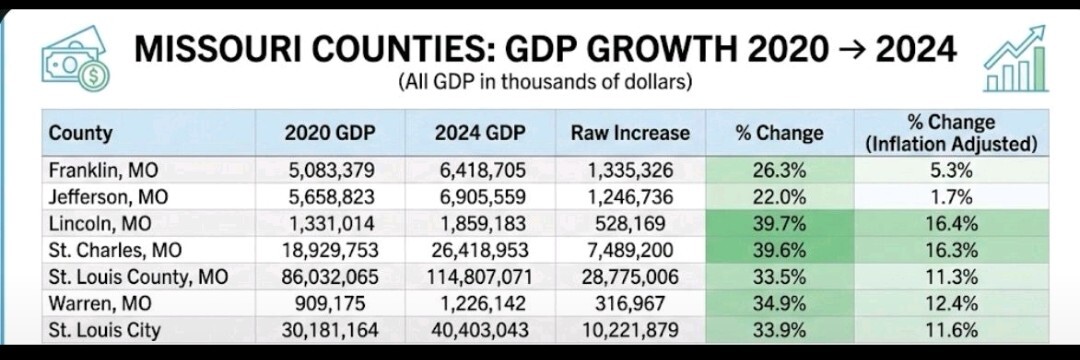
With a four-year average growth rate of 1.7%, Jefferson County is economically declining.
40% or more are over the age of 65.
The School Districts are the county's number one employer.
Approximately 76 percent of Jefferson County residents are employed outside of the County by comparison – St. Louis County, MO (17.3 percent), St. Charles County, MO (3.7 percent), St. Francois County, MO (3.5 percent), Franklin County, MO (3.2 percent), Ste. Genevieve County, MO (1.5 percent), Washington County, MO (1.5 percent), St. Clair County, IL (1.1 percent)
So, what does all of this mean? Why does it matter?
First, I fully appreciate that many want JeffCo to stay exactly as it is. I agree that some parts should. I am not, and will never, advocate the path St. Charles County took, with everything, everywhere, all at once. That is not a plan but rather poor management and even poorer planning. My family loves the beauty and culture of Jefferson County. Why would I want to give that up? I do not.
If you study the graphic at the top, you will see that over the last four years, JeffCo has been stagnant. Think about St. Louis City, which most believe is in an economic freefall; St. Louis County, managing the decline; and Franklin and Lincoln. Do we even know what they have? Yet our community is woefully behind all of them. Here’s the point. That economic gap is costing Jefferson Countians money! It's costing our schools, local governments, and everyday residents. How? Let's count the ways.
Approximately 76 percent of Jefferson County residents are employed outside the County. This means they face higher gas costs, including gas tax, fuel consumption, and vehicle wear. We pay higher sales taxes on everything purchased in another county. The local governments are not capturing these sales taxes for our communities. Commute times are an important factor in determining the quality of life. We need an economy that enables our residents to stay in Jefferson County.
40% or more are over the age of 65.
The School Districts are the county's number one employer.
These two statistics are in direct opposition. As the population ages, fewer children are part of the community. The schools, being the number one employer, will suffer. Schools receive federal and state funds based on school populations. As these dwindle, so does federal and state support. This, in turn, will force higher taxes on the schools to continue to function at the current level. Not a higher one, no new programs or projects, just to survive.
As our population ages, the burden on first responders and local government agencies increases. These agencies, along with schools, depend on property taxes. This burden alone will strain the resources of county and local governments, which will, in turn, force higher taxes to meet the need. Again, this will be higher taxes to maintain the status quo, no new improvements, no new programs, no new…anything.
Jefferson County has a median household income of $80,522.
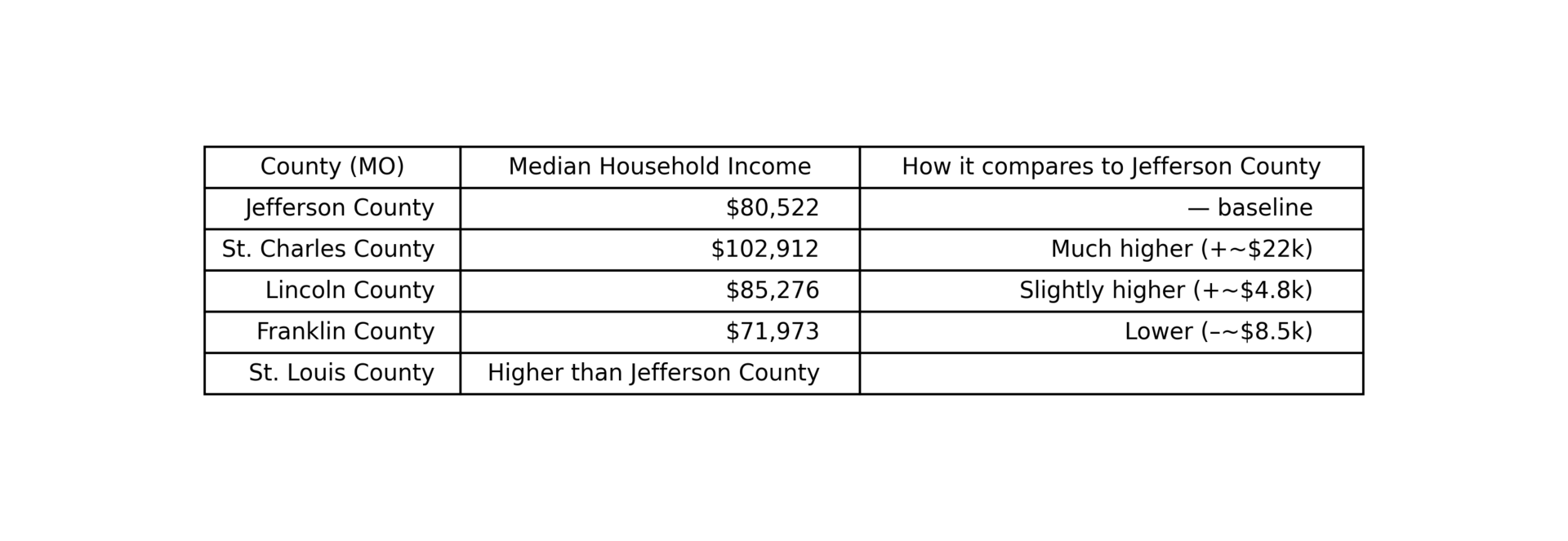
We can do better. Many potential projects and developments can improve this statistic. Wages are artificially low nationally. Jefferson County is not very competitive.
For Jefferson County to thrive, it needs real development, better wages, a solid tax base, and improvements in residents' quality of life. Again, I will state – I do not want to see rabid development that is not directed and produces more “noise” than production. We must decide what our county will look like in ten or twenty years. We must take control of our shared destiny. Trust me on this, if we do not take control… others will step in to do so, make a profit, and not care how we feel about it. That is what happened in St. Charles ten years ago. We can do better.
Port project – While I understand the fear that can come from not fully understanding this project, nothing in the entire state of Missouri will have the positive economic impact this project will. If the state could bring in 4 NFL teams without any incentives, it would not come close to the economic impact of this project over ten years. By creating a third port of entry into the United States through New Orleans and into the heart of the country, we open up a new economic reality of lower costs and higher tax revenue for all of Jefferson County. This does not even begin to include the multiplier effect of new related businesses that will come here.
Regional producers will have a much cheaper way to move goods in and out of the Midwest to the rest of the world. It will cost producers hundreds, not thousands, to move these goods. Farmers will have improved shipping terms and transit times. Other manufacturers will be able to bring in raw materials faster than before and achieve significantly shorter turnaround times, getting their goods back to the market. Jefferson County will become the center of that universe, even as other states develop similar projects.
What was true 150 years ago will be true again along the Mississippi River. Jefferson County will be the beneficiary, provided we agree to work on these developments. Stagnation kills economies. The potential for small businesses would mean a generational change in wealth for local businesspeople. New Orleans and Herculaneum would become the new center of shipping into and out of the US.
Data Centers – I currently serve on the Jefferson County Council Economic Development Committee as a citizen advisor. There is a mountain of misinformation about modern data centers. Remember this: in the tech universe, ten years is a biblical generation. What was once true is no longer. 2026 data centers are considerably quieter, use far less water than farms, and are significantly more energy-efficient than previously thought. Yes, they consume significant power. Yes, the startup uses a lot of water, and yes, they produce an unparalleled economic impact.
Again, it's just not the center itself. The hundreds of ongoing union jobs. The need for more restaurants and small related businesses, and the potential for new families to move into our county. The millions in new tax revenue for the county and related municipalities. These new tax dollars could keep the county and municipalities from raising taxes for years to come.
These are just two significant options available to Jefferson County. Many more exist. To repeat, I am not, and will never, advocate the path St. Charles County took, with everything, everywhere, all at once. That is not a plan but rather poor management and even poorer planning. My family loves the beauty and culture of Jefferson County. Why would I want to give that up? I do not. I want a JeffCo that is in control of its destiny, has a plan, and, most of all, retains its uniqueness. To quote Ronald Reagan – we are “at a time for choosing.” We need to choose wisely.
Chris Grahn-Howard is the Budget Policy Coordinator for the St. Louis County Council. He previously served as the Deputy Legislative Director to the Speaker of the Missouri House and worked with St. Louis County Councilmembers Mark Harder and Greg Quinn.
He has been a published author and senior writer for Christian Times Magazine since 2017—a conservative publication distributed internationally in over 180 countries—and for Capital Times Magazine. His writing covers Christian issues, current events, and public policy, including in-depth interviews with candidates.
Chris has become a subject matter expert on caucuses and primaries, significantly shaping Missouri’s GOP caucus system. He served on the 2019 St. Louis County Charter Commission and was Chair of the Convention Rules Committee for the Missouri Republican Party in 2016 and Vice Chair in 2024. He is a former Republican township committeeman and has been a member of the Missouri Republican State Committee for 12 years, serving as a delegate to the Republican National Conventions in 2012, 2016, and 2020, and as a member of the National Rules Committee for the 2024 RNC.
In 2016, Chris hosted the radio program Conservative Conversations with Chris Howard. He has worked on political and issue campaigns at all levels and is the past Chair of the Board of Directors for the St. Louis Ballet.
He lives in Cedar Hill, Missouri, with his wife, Becky. They have been married for 36 years and love their community.